Posts Tagged ‘voice’
Why?
Wednesday, April 20th, 2011Why am I writing this blog post? Because I want to remind you to take the time to stop and consciously ask yourself, “why?”. “Why?” is a question that we often forget to ask ourselves as we go about our day or do our jobs. Typically, we either know the answer (or think we do) based on past experience or we simply do what we always do out of habit. We also have a tendency to do things because someone told us to, but without asking ourselves why doing what they said is the right thing to do. Taking the time to ask and answer this simple question can be very enlightening. It can also help you make better decisions about gear, deliveries, production and maybe even your life… but today, we’ll just focus on your career.
If your shopping for new gear ask yourself:
Why do I need new gear?
Why am I considering this microphone?
Why do I like this mic preamp?
If your in the booth reading a script ask yourself:
Why am I using this emphasis or these inflections?
Why is this the direction that has been given?
Why is this the right delivery?
If you are doing editing and production ask yourself:
Why am I using several compressors, 2 EQs and a limiter on this channel?
Why does this take sound better than that other one?
Why will this music bed work better than another one?
If you are directing, writing or preparing for a voiceover session ask yourself:
Why is this the right voice for my production?
Why don’t I try reading this out loud and use a stopwatch to see if it fits in time?
Why is this talent taking 42 takes to read my :05 tag?
Sometimes the answer is obvious and you can answer the question of “why?” easily. Sometimes it leads to more questions. Either way, taking the time to consciously ask often produces more definitive answers and ultimately greater awareness. While we rarely stop and take the time to ask ourselves this most basic question, doing so can often change the way we look at what we do and how we do it. It keeps us thinking, growing and improving. Why would anyone question that?

Change Is Good
Wednesday, April 13th, 2011
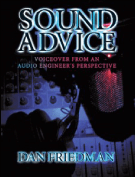
Since returning from Italy a couple of weeks ago, I’ve been dealing with a trademark issue regarding the name of my website. While I won’t express my thoughts about the need for this change or even get into the specifics, I will say that it is great to know that my book SOUND ADVICE – Voiceover From An Audio Engineer’s Perspective, my blog and my presence in the VO world are getting noticed. I greatly appreciate the kind and supportive messages I’ve received in response to the book and also my blog articles, both on my site and on the ProComm Voices website.

I want to take this opportunity to thank attorney and voice actor Rob Sciglimpaglia for his help with the trademark issue. A couple of days before I left town, Rob “friended” me on Facebook. I didn’t know Rob, but I knew of him. I had read some of his postings on various voiceover related forums and websites. As fate will have it… Rob’s timing could not have been better. When I returned from my trip, waiting for me, was a letter informing me of the trademark issue. I immediately contacted Rob. He was very helpful, friendly and responsive throughout the whole process. It is nice to know that there is an attorney who not only understands the legal issues related to our business, but also actively participates in it as a voice talent.
Change is a certainty in life. Although we don’t always get to choose when a change happens or becomes necessary, it still often leads to bigger and better things. With this in mind, I’m announcing that SoundAdviceVO.com is changing its name to Sound4VO.com and my facebook page, SoundAdvice – Voiceover, will also change to Sound4VO. Please make a note of these changes.
My mission (which remains the same) is to help voice talent everywhere sound their best and to effectively communicate the messages of my clients for whom I provide my voice. I look forward to helping voice actors with their equipment, studios, demos, and deliveries and also to sharing the knowledge I’ve gained from years of experience on both sides of the microphone with our industry. I love my job!
TONIGHT is the drawing
Monday, April 4th, 2011I’ve been away for a couple of weeks (one of those in Italy), but I’ve returned and am looking forward to getting back to blogging and helping VO talent sound their best.
Tonight I’ll be drawing the name of the winner of a copy of SOUND ADVICE – Voiceover From an Audio Engineer’s Perspective. Today is your last chance to post a photo of your home studio setup to facebook and tag me in the photo. Thanks to everyone who entered. There are some great looking studios out there!
I’d also like to mention that there will likely be some changes coming to both my website and facebook page for the book. I’ll keep you posted.
Have a great day!
Dan
Use Your Voice, But Be Careful What You Say
Wednesday, March 16th, 2011
Gilbert Gottfried has tweeted himself out of a VO gig. Tasteless comments he posted on Twitter about the Earthquake and Tsunami in Japan led Aflac to fire him as the voice of the Aflac Duck.
Once again this proves that in our brave new world of social networking, you must carefully consider everything you say and/or post. An online presence is essential for all businesses and that presence must be perceived as positive in order to succeed. There is no doubt that contemplating everything you say or write can be exhausting, but failing to do so can be disastrous. Also it is not just what you say, but when you say it. It is a universal truth that, in comedy, timing is everything. Clearly Gottfried’s statements were tasteless, but their timing even more so.
Gottfried is (arguably) a comedian. Comedians are expected to push the boundaries and we would probably not find many of them funny if they didn’t. However, he is also a celebrity voice talent who is closely associated with the Aflac brand. Anyone in a position such as this should feel some sense of responsibility and concern for their client. They should take into consideration how their client may be perceived when expressing a thought, opinion, or even making a “joke.”
“When it comes to social media, praise publicly… insult privately.” This is a phrase I was recently introduced to by my good friend Mercedes Rose. However, didn’t our Mom’s also say it best when they told us, “If you can’t say anything nice…don’t say anything at all”?
ALSO Posted on The PROCOMM VOICES Blog
Use Your Tool
Saturday, March 12th, 2011
Did that headline grab your attention? Good. But please get your mind out of the gutter. What I’m referring to of course, is your voice and I’m suggesting that you use it in new ways. Let me explain…
Last night I had the pleasure of emceeing our Cub Scout Pack’s Pinewood Derby. For those of you who don’t know… the Pinewood Derby is where Cub Scouts race wooden cars that they’ve built down a long sloped track. The Pinewood Derby is one of the biggest events in cub scouting each year and it is taken very seriously (especially by the Dads). Each car is weighed-in and raced down every available lane in a series of heats to ensure fairness. The results of each heat are captured electronically with a motion detector at the finish line. By the end of the night, winners are announced for each rank as well as the overall pack winner. Most importantly, everyone gets really excited during the event and has fun.
So, how does this relate to voiceover? Simple really. As I mentioned, I emceed the event. I was not expecting to be in this role, so it was a bit of a surprise (like getting a script just as a session is supposed to begin). The Cubmaster had planned on doing it but was not feeling well, so he asked if I would.
This scenario is quite a bit different from being in a quiet room where nobody even sees me when I’m working (engineering or voicing). It got me behind the microphone in front of a large, noisy and yet still somewhat intimate crowd. Having been a live sound engineer and in radio for a number of years, my only stage experience consists of announcing bands to completely impersonal crowds of thousands or to saying “one, two, one, two” to test microphones. So… this was a very different experience for me.
I had no idea what I was going to say to keep the crowd entertained throughout the night (ugh, where’s my script?) but began by welcoming the crowd, announcing the event and just taking it from there. As the night went along, it got easier and more fun. I took on the role of an announcer, just as I would if I were in the booth reading a script. By the end of the night, several people had come up to me to say that I “missed my calling” (which I thought was kind of funny). It was fun to use my voice in a completely different way and in a completely different setting.
Versatility is a key component to success in voiceover. The more styles and deliveries you are able to successfully provide will open doors to greater and more varied opportunities. Putting yourself in different situations, such as going to another studio or on stage will give you more confidence and invaluable experience. If your current specialty is to be an announcer, practice reading as a story-teller or develop a character.
So, get out there! Try new things and use your voice (your tool) in the same way a scout uses a pocket knife… as a multi-tool.
- Dan
Is Creativity in Commercials Making a Comeback?
Friday, March 11th, 2011
For a long time, I’d say the last couple of years at least, it seemed that the vast majority of scripts I was recording, mixing, or voicing were simple voice and music spots. Lately though, I’ve noticed more dialogs as well as scripts with interesting scenarios and an abundance of clever lines. To all of the writers and ad agencies out there who are responsible for this… let me express my gratitude. What a welcome change!
Every single aspect of this great business gets even better when creativity is injected into the process. Recording sessions are more fun as talent get to interact and react in response to one another or their lines. Mixing is more fun with greater opportunities for sound design. Most importantly, the spots are more interesting and attention-getting when on the airwaves. Naturally, the concept must be well executed, but that is for another article. I don’t think I’m out of line by suggesting that nearly everyone prefers to listen to a compelling or clever story rather than be told what to do, or worse, shouted at (just ask my kids).
During the last several weeks I mixed a spot for a bank that placed a character in a silo to demonstrate that people can truly do their banking from anywhere. I voiced a spot that included clever and relatable lines in response to a kid who couldn’t stop asking, “why?” I’ve worked on a hospital spot where a husband took the lead in helping his wife prepare for surgery. These are just a few examples out of many. While I haven’t done any scientific studies (although there probably are some), I’m convinced that people are more likely to turn up or tune in to a commercial if it offers more than just price points and deals. The VW commercial that premiered during this year’s Super Bowl is a perfect example. It is cute, it is compelling and it tells a story (okay, so it does not include voice over… nothing is perfect).
Today’s technology makes sound design easier and faster than ever. Therefore, creativity doesn’t have to cost a lot more. As a VO engineer and producer I love creating a scene with sound. As a voice over talent, I love to communicate the unspoken messages of a script just as much as the spoken ones. I don’t know of any producers or voice talent who would not prefer to fully utilize the skills they’ve developed in their craft. My guess is that, if you are a writer, being creative and clever to effectively communicate a message is equally rewarding. So, to those writers out there who are bringing creativity back… thank you! I encourage you to keep it up and I look forward to helping you and your clients sound great.
Directing Voice Talent: Better Communication, Better Results
Friday, February 18th, 2011You’re about to direct a voice over session. You may be producing a TV or radio commercial. Maybe you’re producing a corporate presentation or program narration. Whatever the project is, your goal will be to get your chosen voice talent to communicate your message(s) to your audience. Your message could be many things, but one thing is almost certain… it is probably more than just the words written on the page. Being able to direct your voice talent to communicate both the written and unwritten messages within your script takes skill and flexibility. You must also be certain as to what your message is meant to communicate. Furthermore, it helps to have the ability to communicate effectively yourself and a willingness to allow your talent and your engineer/producer to help you achieve your goal.
Who Will Deliver and How?
The most important thing to know and understand before beginning is… your message. What do you want your message to be? What emotions are you trying to evoke in your audience? The answer to these questions will determine how you want that message delivered and who will be best at delivering it. Your choice of talent is critical. Often a voice talent with a bold announcer’s voice will be chosen to do a role that would be better suited to someone with a regular-guy/gal voice, and vice-versa. These contradictions make it difficult to hear the message beyond the voice. Simply hearing a nice voice speak your written words is not enough. The emotion comes from how those words are delivered. As the director, you need to determine what voice is right for a role, as well as the type of delivery that will communicate your message and elicit the desired response from your audience.
Professional voice talent should be able to look over your script and know reasonably quickly what type of delivery is required. Most often the words will dictate what the message should be. However, as the talent reads the script aloud, the director should be listening for the nuances in the delivery. There is more than one way to effectively communicate a message and the director should be sure to listen carefully to those nuances and determine which communicates the message best.
Keep it Simple and Clear
When offering direction to voice talent, keep it simple and succinct. The more direction you offer at one time, the less likely you will be to get everything you need or want.
Lots of directions… often lead to contradictions. These contradictions lead to confusion. This invariably means that it will take more time to get your message where it needs to go (which possibly means spending more money as well). Directing a voice talent is analogous to being a passenger in a car and telling the driver where he or she needs to go. If the passenger tells the driver to go both right and left at the same time and at the last possible second, the driver is likely to crash. Even when the direction is clear, offering too much direction or too much explanation, can also present a problem. Going back to the passenger and driver analogy; if the passenger tells the driver he’ll have to turn right but then continues to explain the right turn or begins to discuss what will happen after that (or really just about anything that takes the drivers attention away from the road), the driver could miss the turn entirely.
Using descriptive and unambiguous terminology is another key factor in hastening your success. Telling the talent to make it “flat”, for example, could mean many things. Does it mean to read without emotion, without inflection, or to simply read the script conversationally and not sound like an announcer? Terms such as: “dramatic”, “forceful”, “proud”, “nonchalant”, “conversational”, with “more/less energy”, or “more/less smile” are much easier to understand. Books about voice over (the same books that voice talent read) can be very helpful when directing. Many offer a more comprehensive list of terms and also explain delivery styles.
Trust Your Engineer
Some voice talents respond very well to concepts. They may want to know who the audience is or what the setting will be. Others need details, such as simple directives about inflections or emphasis on a line or word. Usually a combination of these things will be most effective. If you do not have experience directing or are unfamiliar with a particular voice talent, the engineer or producer can be a tremendous asset. Allow them to help you. One of the great things about working with an engineer or producer who is experienced in voiceover is that they often work with many of the same people on many different projects. They get to know the talent well and know how each responds to different ways of directing. If you are having trouble explaining what it is you want to hear, the engineer or producer may be able to interpret your needs and convey them to the talent in a way that the talent responds best.
Line Reading… The Last Resort
Still not able to get what you want from your voice talent? As a last resort… offer a line read. It is rarely a good idea to start a recording session by offering a line read. Line reading is usually unnecessary and can be misleading. After all, the talent was hired for more than just their voice. They were also hired for their interpretation skills. William Shatner famously coerced a director to line read for him after the director gave Mr. Shatner several unnecessary directions about his delivery. Needless to say, the director couldn’t begin to deliver the message like William Shatner, and Mr. Shatner was quick to let him know it. That session is legendary in the voiceover community and the audio is available here.
This director surely learned that line reading can lead to big problems. Thankfully, most voice artists will not be as brazen as Mr. Shatner was with this particular director on that particular day. Many voice artists will kindly ask for a line read after they’ve made several attempts and still aren’t delivering a line the way you hear it in your head. Most voice talents are very appreciative to have been chosen to deliver your messages. They are more than willing to do what is necessary to give you the read you want. That being said, it is still a good idea to save line reading for small parts, pronunciations and when all other methods of communicating your needs have failed.
Directing a voiceover session can be the easiest and best part of your workday. If you understand your messages and communicate them to the talent and the engineers/producers as simply and clearly as possible; you’ll be able to sit back, relax and allow the talents of your chosen voice artist, and engineer, communicate your message to the world.
Copyright protected by Digiprove Are You Ready to Make a Voiceover Demo?
Monday, January 24th, 2011Am I ready to make a voiceover demo? This may be the biggest question any aspiring voice talent will ask. With all of the attention the voice over industry has received lately, it is no surprise that many people are asking this question right now. If you are new to the industry, there are several questions you should ask yourself (and ask others) before making your first demo. By answering honestly, you will have a much greater understanding of where you are in your career and whether or not you are truly ready to make a voiceover demo.
More Than Just a “Nice Voice”
Simply having a nice voice is not enough to achieve success in this business. There are several basic things you should be able to do before taking your desire to work as a voice talent to the next level. If you are unable to effectively communicate the message of a script or have trouble following and implementing given directions, then you are not ready to make a demo. If your reads almost always require editing and compiling of multiple takes of the same copy to get the correct inflections, energy or delivery into one cohesive piece of audio, then you are not ready to make a demo. Ideally, you should be able to read a well-written script from top to bottom, and communicate the messages of that script, without stumbling or requiring extensive editing. Prior to digital recording and editing… this was the standard.
What is a demo?
You probably know, or think you know, what a demo is. It is a representation of how your voice sounds and your ability to perform, right? Yes, but it is more than just that. Your demo is your business card, your resume’ and the number one way to be considered for a job or representation. Your demo should be interesting, perhaps even exciting and make someone want to hear more of you. It should not overstate or misrepresent who you are or your ability. It should accurately reflect your sound, style(s) and ability to deliver copy.
Where to Start
What do you need to get started on your demo? You will need some material, or scripts, to create your demo. This material should come largely from actual work that you have done. If you don’t have any then you should use material from voiceover workshops that you have taken and scripts from practice sessions. You have taken a workshop and had almost daily practice sessions… haven’t you? If the answer is “no” then you are not ready to make a demo. The most important thing to know before making your first demo is that, before even considering it, you should have been doing voiceover on your own for quite some time. In other words, you should have been practicing. How long do you need to practice? Only your ears and the ears of others can tell you when you are ready.
Get Help
Do you know an engineer, producer or director (or someone with voiceover experience who can perform these rolls) who will be completely honest with you about your deliveries? Does this person know how a voiceover demo should sound and how to produce a demo specific to your skills or what style you wish to present? Making a demo is not something you should do on your own. Even the most experienced voiceover talents know that a second set of experienced ears is critical to making a great demo. You will need someone to help direct you, make choices on what should be included and what should be left out. More importantly, you can only learn about the industry, from someone who works in the industry. Read books. Network. Attend workshops, classes and seminars. Make connections and don’t be afraid to ask questions.
Environment and Equipment
Ideally you should record your demo in a professional recording environment where you can focus on your deliveries and let someone else focus on the equipment. However, not all recording studios work with voiceover talent and simply having the equipment to record audio or even recording experience, does not mean that the studio engineer knows what is needed for voiceover. Furthermore, they may not have the music and sound effects libraries required to fully produce a professional sounding demo. Find a studio that does. Invest the time and money to have your demo done right.
Getting the Job Done
Speaking of equipment, do you have the necessary equipment to actually do a job? More importantly, do you know how to use it? These days being a voiceover talent usually requires more than a great voice and the ability to use it. At a minimum, you have to know how to record and edit. You also need to invest in the proper equipment to do so. This requires a good quality microphone, preamp, interface, computer, recording software, headphones, cables and ideally a sound-proof/acoustically treated room. This equipment needs to have the capability to reproduce your voice accurately without any electronic noise, distortion or coloration.
What Do You Do Best
What is your specialty? What do you do best? The answer to these questions will determine what kind of demo you should make. There are many different types of voiceover work and your first demo should communicate what you do best. Commercials, phone systems, audio books, promos, imaging, characters and narrations (just to name a few) are all very different styles and formats. While there can be some overlap among them on your demo, you should be certain the emphasis is on what you do best or on the type of work you seek.
Final Steps
How should your demo sound when complete? It should be fully produced. It should have music and/or sound effects where necessary. It should have several vignettes that reflect your style and versatility. It should be interesting and hold the listener’s attention as it flows effortlessly from one spot to the next. It shouldn’t be more than a minute and a half long (although a minute to just over a minute is preferable). Most importantly, it should have your name and contact information on the physical medium itself. If you are sending it electronically be sure that the file contains your full name and the email contains several clear ways to contact you.
Making a demo is a critical step to taking your career to a professional level. I often receive submissions that are intended to be demos, but simply aren’t. Snippets of home recordings, answering machine messages and recorded ramblings of voices that you “like to do”, do not qualify as a demo and are a clear indication that you need training, experience and professional help. Perhaps in more ways than one for some people… if you could hear these you would know what I mean! I also frequently receive great sounding demos from “talent” who fall short of expectations when put to a live-session test read. Unfortunately, these people almost never get a second chance.
Your demo is vital to your success. Do not try to “go it alone”. Have it made with the help of industry professionals. Do not send out material that really isn’t a “demo”. Most importantly, be sure you are truly ready to take this important step by having a great sounding demo and being able to deliver on what your demo promises.
To listen to my latest demos visit:
For some examples of other great sounding demo’s visit the ProComm Voices website at:
Copyright protected by Digiprove A True Story and Advice On Voiceover Demos
Monday, January 10th, 2011Last week I received a call from a young lady who wanted to make a voiceover demo. I asked her if she had ever done voice over’s before. She replied, “no”. I told her that I could make a demo for her that would make her sound great, however I would not do so without (at least) knowing what her current abilities were. I offered her a training and evaluation session where I would have her read some scripts, determine her abilities and offer direction and advice to help her get started in the business. If it turned out that she was ready, then we could talk about making a demo.
She was not interested.
I explained that it would be a “bad idea” to immediately make a demo since she had no experience. To do so would simply set her up for failure. The demo would misrepresent her, making it appear as though she were an accomplished voice talent, and if and when she got a job from this demo she would likely struggle and possibly fail miserably in a real recording session. “That situation could end your career before it even got started,” I told her.
The young lady explained that with her “experience” (she was fresh out of college from what I could ascertain) and “background” (as a singer) she would be fine. “This won’t happen to me”, she said. She also told me that since she has ProTools at home she would just make her own demo. I wished this young lady “good luck”.
I told this story to my wife and she said, “If the girl wants a demo, you should just make her a demo.” I know where my wife was coming from, if someone wants something and is willing and able to pay for it why not give it to them? I told my wife that by doing so, I would be misrepresenting this girl and setting her up for failure, I would also be compromising my own integrity as well as the integrity of an industry already suffering from an influx of amateurs, who have no experience, but have been told they “have a nice voice”.
I take the voiceover business seriously and I believe I have a responsibility to set the talent bar high. If you want to work as a voice over talent… go for it! But WORK at it. Invest some time and at least some money by taking a workshop, reading some books about the industry, listening and practicing. By the time you are ready to make your first demo, you should have been doing voiceover on your own for quite some time. In other words, you should have been practicing. How long do you need to practice? Only your ears and the ears of others can tell you. You should be able to convey the messages of a script (both written and unwritten) effectively, with NO EDITING REQUIRED
Making a demo is a critical part of your career. It is your business card and your resume’. When you submit a demo, you are applying for a job. In most industries, if you lie on your resume’ and the lie is discovered, you would be fired. Similarly, if your demo misrepresents you and your abilities, you are putting yourself at risk of being fired from a job. Furthermore, you are putting your reputation at risk, which could prevent you from getting future jobs (even if you’ve decided to put in the necessary practice time). Misrepresenting your abilities can be a serious burden on your desire and even your ability to have a career in voiceover. Unfortunately I receive great sounding demos frequently from “talent” who fall short of expectations when put to a live-session test read. These people almost never get a second chance.
The bottom line: If you want to break into the voiceover industry, be patient and practice. Record yourself and listen. Have others listen as well. Train your ears and your voice. Spend time with working voice over industry professionals. Do not set yourself up for failure and frustration. Do not make a demo until you are ready.
One additional message for engineers, producers and directors: help yourself, help the industry and help the talent (both new and experienced). Do not make demos for people who are not ready. This may save you and many others, time, frustration and money down the road. Furthermore, and more importantly, it raises the talent bar for the industry as a whole, helping to ensure that only truly talented professionals are working beside you.
Copyright protected by Digiprove