Posts Tagged ‘Recording’
Recording Magazine’s Room Acoustics Series – Part 5
Wednesday, September 28th, 2011Recording Magazine sends out a newsletter to its subscribers every few weeks. The newsletter is (coincidentally) titled “Sound Advice” and this month it features the fifth in a series about room acoustics. Room acoustics is one of the biggest concerns for Recording Magazine readers. I know that this is also a big issue for those of you in the voiceover world. I asked permission to reprint this newsletter (and will ask to reprint the others in the series as well) so that those of you with home studios can also benefit from the information. I want to personally thank Brent Heintz, VP/Associate Publisher for granting permission, allowing me to share this great information with you.
Please visit Recording Magazine‘s website:
http://www.recordingmag.com
and their Facebook Page
http://www.facebook.com/pages/RecordingMag/174861759224348
Here is the fifth newsletter in the series on Room Acoustics:
Welcome to Sound Advice on Acoustics! For the past several months we’ve been dealing with the basics of controlling bass buildup in rooms, using ratios of room dimensions and active bass trapping and other room treatments. Bass is by far the hardest problem to deal with in tuning a room, and with it under control, we can now turn our attention to the mids and highs. Read on…!So far we’ve considered the effects of low-frequency waves in the room. There are other issues, related to the propagation of mid and high frequencies. When a mid- or high-frequency sound wave moves through a room, it eventually hits one of the various boundary surfaces (walls, ceiling, floor). When this occurs, the sound wave is either absorbed, transmitted, or reflected.
Absorption means that some or most of the wave’s energy is converted into heat. Transmission means that the wave has some of its energy passed—through the wall, for example. Reflection means that most of the wave’s energy is directed back into the room.
This will happen repeatedly as the sound wave hits various surfaces until all its energy is eventually dissipated.
A room where all the surfaces are completely absorptive sounds dead and unnatural, and is unsuitable for music-making or listening. Such a room, called an anechoic chamber, would be used for testing purposes, as in the manufacture of loudspeakers for example, to isolate the sound quality of the speaker under test from the room effects. An overly reflective room is also not ideal—too many reflections tumbling around the room obscure the clarity of music or speech (see below).
An ideal room strikes the right balance between the original sound from the source (i.e. instrument or loudspeaker) and the amount of reflected sound present. Furthermore, it is desirable for the reflected sound to be distributed as evenly as possible throughout the room, providing a comfortable and pleasant sense of ambience (liveness). This even distribution of reflected sound energy is called , and is generally desirable, as we’ll see. But along the road to this ideal room, there are many pitfalls that we’ll now examine.
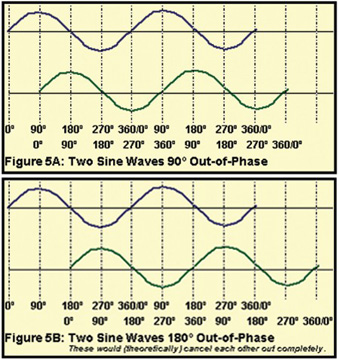
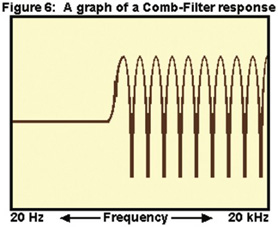
Reflection of sound waves is the behavior we’ll be most concerned with in the next few paragraphs. Just as happens with lower frequencies, when mid- and high-frequency waves reflect back into a room, the positive and negative peaks of the direct (original) sound waves and those of the reflections will cancel and reinforce. This happens because the reflections are delayed in time relative to the direct sound, causing their positive and negative peaks to be offset from those of the direct sound, which results in the interference (see Figure 5 for an illustration of this).


While this resulting frequency response may look very ragged, in actuality our hearing systems tend to average out and largely gloss over these subtle, myriad cancellations and reinforcements, and instead may perceive this as a not unpleasant coloration of the sound in a casual listening environment.
However, a recording studio is not a casual listening environment. For example, we depend on what we hear in the control room to make important decisions about the way the sounds in a recording blend and balance. We need to hear exactly what’s in the recording, not a “pleasantly colored” reproduction. Consequently, we need to exert some degree of control over any such effects that impact the neutrality of the monitoring environment.
With all this knowledge under our hats, it is time to look at another fundamental (excuse the pun) aspect of acoustics: how we hear. Next time: a crash course in how our ears and brains interpret sound. See you then!
Voiceover Gear, Quality and Rates… a Correlation?
Saturday, August 13th, 2011Two of the biggest ongoing issues in the voiceover world are gear and rates. It seems that voice talent (or voice talent wannabes) are always looking for the latest, greatest, smallest and cheapest piece of gear that is good enough to record audio. They also seem to want the ability to do this from just about anywhere. The issue of rates is always a big concern. Job offers for payments that fall considerably short of generally accepted rates frequent the internet. These offers are often discussed as being reprehensible or even laughed at on social media. So, is there a correlation between cheap gear and low rates?

Portability and the ability to respond quickly to client requests are key factors that drive the need for much of this gear. The desire to provide for clients is essential to your VO business and let’s face it, the gear is often pretty cool and some of it sounds quite good. But the environment plays a much bigger role in your overall sound and just because you can record from your car or a hotel room, doesn’t mean you should. Other than your voice and performance, nothing has a greater effect on your sound than the environment you’re in.
Consistency and quality are critical for great sounding productions. These can only be guaranteed when the environment is a professional one, usually a professionally equipped recording studio or home studio. Consistency is especially critical when it comes to revisions. Even musicians, who are the largest consumers of recording gear, know that most of this low-end gear is for laying down ideas and for doing pre-production. When they are ready to make an album, serious musicians will usually go to a professional recording studio.
One of the biggest complaints about the voiceover industry, from those who are in it, is that so many people think that voiceover is easy and anyone can do it. Well, it should come as no surprise that when people brag about recording from their car, on their smart phones and through the multitude of cheap pieces of plastic that are now available at the megastore down the street, outsiders may believe that this is not all that difficult. Newbies don’t always understand performance or quality, but they usually understand the concept of making money from anywhere for very little investment.
On the flip-side, clients who (to their detriment) don’t always care about quality are not going to offer higher rates if they think the job can be done anywhere and/or with nothing more than a USB microphone plugged into a laptop. Clients who know better are usually willing to pay for the quality and service that come with a professional talent, who records in a professional environment, on professional gear. They understand that, just like in their own businesses, to be among the best requires an investment in time and money. Clients can justify higher talent payments more easily when they know that the audio will be professionally recorded and will be consistent from one session to the next.
Having higher-quality equipment and a proper recording space helps you to justify demanding a higher price for your work. Good clients understand that your investment in training and gear has value and the results will speak for themselves.
If you are a voiceover talent, who loves and respects this industry, you will hopefully continue to work towards providing the highest quality audio possible and consistency from one session to the next. This doesn’t mean that you should not provide for your clients in emergency situations… you should. It also does not mean that you must have the most expensive pieces of gear. It simply means that you will continue to seek out the best equipment for you and your situation until you reach the point that any change would not provide a significant improvement. Do not stop at “good enough”.
Why?
Wednesday, April 20th, 2011Why am I writing this blog post? Because I want to remind you to take the time to stop and consciously ask yourself, “why?”. “Why?” is a question that we often forget to ask ourselves as we go about our day or do our jobs. Typically, we either know the answer (or think we do) based on past experience or we simply do what we always do out of habit. We also have a tendency to do things because someone told us to, but without asking ourselves why doing what they said is the right thing to do. Taking the time to ask and answer this simple question can be very enlightening. It can also help you make better decisions about gear, deliveries, production and maybe even your life… but today, we’ll just focus on your career.
If your shopping for new gear ask yourself:
Why do I need new gear?
Why am I considering this microphone?
Why do I like this mic preamp?
If your in the booth reading a script ask yourself:
Why am I using this emphasis or these inflections?
Why is this the direction that has been given?
Why is this the right delivery?
If you are doing editing and production ask yourself:
Why am I using several compressors, 2 EQs and a limiter on this channel?
Why does this take sound better than that other one?
Why will this music bed work better than another one?
If you are directing, writing or preparing for a voiceover session ask yourself:
Why is this the right voice for my production?
Why don’t I try reading this out loud and use a stopwatch to see if it fits in time?
Why is this talent taking 42 takes to read my :05 tag?
Sometimes the answer is obvious and you can answer the question of “why?” easily. Sometimes it leads to more questions. Either way, taking the time to consciously ask often produces more definitive answers and ultimately greater awareness. While we rarely stop and take the time to ask ourselves this most basic question, doing so can often change the way we look at what we do and how we do it. It keeps us thinking, growing and improving. Why would anyone question that?
Room Acoustics Series… Thanks Recording Magazine
Tuesday, April 19th, 2011Recording Magazine sends out a newsletter to its subscribers every few weeks. The newsletter is (coincidentally) titled “Sound Advice” and this month it features the first in a series about room acoustics. As you will read, room acoustics is one of the biggest concerns for Recording Magazine readers. I know that this is also a big issue for those of you in the voiceover world. So, I asked permission to reprint this newsletter (and will ask to reprint the others in the series as well) so that those of you with home studios can also benefit from the information. I want to personally thank Brent Heintz, VP/Associate Publisher for granting permission, allowing me to share this great information with you.
Please visit Recording Magazine‘s website:
http://www.recordingmag.com
and their Facebook Page
http://www.facebook.com/pages/RecordingMag/174861759224348
Here is the newsletter:
Welcome to Sound Advice on Acoustics! In a recent survey of our readership, the number one answer to the question, “What do you feel most limits the quality of your home recordings?” was “Room acoustics.” There’s a lot to learn about the subject of acoustics, and the more you know, the more tricks you can master to get your room sounding its best.
New York-based producer/engineer Joe Albano brings us the first installment of a multipart primer on acoustics to get this newsletter started, and over the coming months we’ll bring you all kinds of useful information on acoustics! Here we go…
***
We’ll start our look at acoustics by briefly reviewing the basics of how sound works.
Sound is created by vibrating objects like guitar strings, drum heads, vocal cords, or loudspeakers; it travels through the air in waves. The waves are alternating areas of higher and lower air pressure; everything we do to control the sound of a room boils down to managing what happens to those waves as they move around the room.
When we talk about a sound wave or audio signal, it has some properties that we’ll need to understand.
1. There’s its amplitude (what we perceive as “loudness”). This is measured indecibels or dB. The decibel is a relative measure of loudness, and needs a reference point to have an absolute value (we talk about 0 dB Full Scale in digital audio all the time, for example). In acoustics, we’re usually talking about dB SPL or Sound Pressure Level, from the threshold of human hearing at 0 dB SPL all the way up to very loud sounds above 100 dB SPL.
2. There’s its frequency, or how many times per second the wave compresses air; it’s measured in wave cycles per second, or Hertz (Hz). We say that the A above middle C has a frequency of 440 Hz.
3. There’s its waveshape. All sound waves are made up of a combination of basic simple waves called sine waves. There’s the lowest frequency wave, thefundamental, and then a mix of higher-frequency information blended into it calledovertones. Every sound has a different blend of overtones over time; that’s what makes a flute playing a C sound different than a horn or guitar playing the same note.
Some overtones are multiples of the fundamental—if the fundamental is at 55 Hz, there may be overtones at 110, 220, 440, etc.. These overtones are called harmonics. Other overtones are inharmonic, without this clear relationship to the fundamental. We hear them as clangorous or noisy, like the attack of a ringing bell or the chiff of breath on a flute.
4. There’s its wavelength… how long a distance you can measure between the start of one wave and the start of the next. This is a really important property, because how a sound wave “fits” into a room has a direct bearing on how loud or controllable it is!
We can calculate the wavelength of any wave if we know its frequency and its speed; this applies to light waves, sound waves, any kind of wave. The formula is simple:
Speed = Frequency times Wavelength, so Wavelength is Speed divided by Frequency.
Now, we know the speed of sound in air at sea level; it’s 1130 feet per second (fps). So a sound wave’s wavelength in feet equals 1130 fps divided by the frequency in Hz.
Here’s a couple of examples: A low E on a guitar has a fundamental frequency of 82 Hz; its wavelength is 1130 / 82 = 13.8 feet. That’s a pretty long wave. Compare that with the highest C on a piano. Its fundamental frequency is 4000 Hz, so its wavelength is 1130 / 4000 = 0.28 feet, or a bit over 3 inches: a much shorter wave.
So, as you can imagine, when we play back music on loudspeakers or have a set of instruments playing in a room, there are all kinds of waves bouncing around at all kinds of wavelengths. When two of them happen to line up so that a high pressure area of one is at the same place as another high pressure area, the overall pressure will be still higher, i.e., the wave will be louder. And when two of them line up so that a high pressure area of one is at the same place as a low pressure area of another, they’ll partly cancel out and the wave will be softer.
In other words: in any given room where there’s sound, certain frequencies will be louder than you think they’d normally be, and certain frequencies will be softer. The room won’t be accurate in representing the actual sound being played, and if you track and mix in such a room then play your music back elsewhere, it won’t sound the way you think it should. Presto: you now know why acoustics and sound control in rooms is so important!
Next time, we’ll start to look at how these properties of sound combine to create real-world acoustic problems. See you then!
Is Creativity in Commercials Making a Comeback?
Friday, March 11th, 2011
For a long time, I’d say the last couple of years at least, it seemed that the vast majority of scripts I was recording, mixing, or voicing were simple voice and music spots. Lately though, I’ve noticed more dialogs as well as scripts with interesting scenarios and an abundance of clever lines. To all of the writers and ad agencies out there who are responsible for this… let me express my gratitude. What a welcome change!
Every single aspect of this great business gets even better when creativity is injected into the process. Recording sessions are more fun as talent get to interact and react in response to one another or their lines. Mixing is more fun with greater opportunities for sound design. Most importantly, the spots are more interesting and attention-getting when on the airwaves. Naturally, the concept must be well executed, but that is for another article. I don’t think I’m out of line by suggesting that nearly everyone prefers to listen to a compelling or clever story rather than be told what to do, or worse, shouted at (just ask my kids).
During the last several weeks I mixed a spot for a bank that placed a character in a silo to demonstrate that people can truly do their banking from anywhere. I voiced a spot that included clever and relatable lines in response to a kid who couldn’t stop asking, “why?” I’ve worked on a hospital spot where a husband took the lead in helping his wife prepare for surgery. These are just a few examples out of many. While I haven’t done any scientific studies (although there probably are some), I’m convinced that people are more likely to turn up or tune in to a commercial if it offers more than just price points and deals. The VW commercial that premiered during this year’s Super Bowl is a perfect example. It is cute, it is compelling and it tells a story (okay, so it does not include voice over… nothing is perfect).
Today’s technology makes sound design easier and faster than ever. Therefore, creativity doesn’t have to cost a lot more. As a VO engineer and producer I love creating a scene with sound. As a voice over talent, I love to communicate the unspoken messages of a script just as much as the spoken ones. I don’t know of any producers or voice talent who would not prefer to fully utilize the skills they’ve developed in their craft. My guess is that, if you are a writer, being creative and clever to effectively communicate a message is equally rewarding. So, to those writers out there who are bringing creativity back… thank you! I encourage you to keep it up and I look forward to helping you and your clients sound great.