Archive for January, 2012

What Do You Believe?

Tuesday, January 31st, 2012

By Dan Friedman

I believe that as an audio engineer, voiceover talent and author, I have a responsibility to you and to the voiceover industry to provide the best and most accurate information whenever I write a blog or am asked to share my expertise. I believe that I have a responsibility to my clients and to those who recommend me, to be the best voiceover talent that I can be. I believe in helping newcomers who have a true passion for voiceover and are willing to work hard to be among the best, as well as those who have earned my respect by demonstrating that they believe, as I do, in raising the bar for this industry. I believe in helping my friends. I believe that being a voice talent and audio engineer is not just about earning a paycheck, its also about the love I have for doing it, the pride I take in doing it to the best of my ability and the joy I get from being a part of this great industry. I believe in earning credibility through accomplishment. I believe in speed, accuracy and efficiency. I believe in being positive and I believe in honesty.

But this post isn’t about me, I promise.

So… why am I telling you what I believe? Because I also believe that many of you could be an unknowing victim of those who are self-proclaimed experts, gurus, coaches, trainers and whatever else they claim to be, when in reality they are either:

- At best, unknowing purveyors of bad information.
- At worst, knowingly trying to capitalize on people’s inexperience, emotions or desires.
- Somewhere in between

Whether you are a pro or just starting out, the possibility exists for you to lose a job or miss opportunities because you were misinformed or misguided by the ignorance of others. Worse than that would be to lose the money you already have to people who are deceptive or trying to take advantage of you.

This past weekend several pros sent emails to me that contained links to things that were either completely inexplicable or simply despicable. While we shared some laughs about what we were witnessing, the prevailing feelings were those of disbelief and frustration. For me, it is disheartening to see, read and hear things that are contradictory to ideas and concepts that I post about regularly in my blog. But what is more concerning is when bad information is being shared that, if mistakenly taken as fact, could hurt someone’s career. I don’t expect everyone to believe in the same principles that I believe in, but some of what I was reading and hearing was outrageous. In at least one instance the information being shared contradicted the laws of acoustics. :-(

I know what you are thinking, WHO? SEND ME THE LINK! I WANNA SEE! I WANNA KNOW WHAT AND WHO YOU ARE TALKING ABOUT!

As much as I would like to share these things, I believe that it is important to let my “keep it positive”  and “praise publicly, criticize privately” mantras prevail. But because it is important that everyone understand just how unbelievable some of this stuff is, without naming any names, I will share one thing to illustrate my point.

If you are one of those folks who is currently seeking voiceover coaching by searching the internet, you might just feel as though you are walking through a minefield. Whether you are new to the industry or a working voice talent wanting to further your training, the choices for coaching are vast. Type “voiceover coaching” into google and you’ll see what I mean. I see over 2 million possibilities. Even if 1% of those are relevant, that is a big number of sites to deal with.

One of these coaching sites had a post that stated it was okay to make mistakes and perform pickups whenever necessary. In the audio presentation, the speaker encouraged it. It was suggested that this could help your delivery. The “coach” actually said, “If God hadn’t wanted you to make mistakes… he wouldn’t have invented editors, editing software…(etc.)” WOW?! Now, even if this was said in jest (and I didn’t get the impression that it was), is this the kind of idea that makes any practical sense at all? If you want to share your paycheck with the editor… it might be.

A proper coach teaches how to deliver a script with all of the feeling, emotion and communicative skills required, without needing pickups to do it. Obviously we all need to pickup from time to time, but that isn’t the point. Imagine what the engineer (or editor) is thinking if your attitude as a voice artist is, “My coach told me that I can screw up as often as I need to, because the engineer will put it together.” Believe me, knowing that there is job security in working with you, will not make the engineer want to work with you even more. Not to mention that more editing requires additional studio time and that will cost your client more money. This is the antithesis of what it means to provide good customer service. Do you think this will put you at the top of the booking list?

Is this the sort of thing that a voiceover coach should be teaching? Do acting coaches teach that it is okay to forget a line or miss a mark because someone else will fix it?

What I’ve just shared with you is absolutely true. But sadly, it is also only one example of bad information out of several I could share. Furthermore, this and the other examples are things that could effect anyone at any level of their career… there is plenty of bad information to go around.

There is not much any of us can do to stop this activity and it certainly is not limited to the voiceover industry. We all know that the internet is full of both good and bad information. Complicating things even more is that the people sharing this information probably don’t know or believe they are wrong, or were just lazy and didn’t do the necessary research before making their presentation. In the example I presented above, its a matter of perspective. The “coach” is only thinking about what seems to be good for the talent (in the short term), not for the engineer/editor and definitely not for the client, which will only end up hurting the talent in the long term.

So what can we do? First, don’t be fooled by slick marketing, websites and web videos. These don’t reveal the whole story. They only reveal what the creator wants you to see and believe. Second, do some research (a seemingly lost art in this country). Usually, a little bit of additional research at undeniably reliable and factual websites will reveal whether someone knows what they are talking about or what they stand for. Use your ears. The best thing about being in voiceover is that there is usually some audio available that can help to confirm whether someone is who they say they are, that they know what they are talking about or whether they can deliver on what they promise.

Generally speaking, I don’t believe that back and forth battles in chat rooms, social media groups and forums are all that productive. Too much context can get lost and intentions can be easily misinterpreted, which has the potential to create even more and greater problems. So finally and most importantly, talk to people with first-hand knowledge of (and experience with) the people you are interested in working with, or who you are getting your information from.  Many people share the mantra “praise publicly, criticize privately” and valuable information will be revealed in private conversations. Communicate with people you trust and don’t forget to trust your own instincts as well.

In the end, it doesn’t matter what I believe or what anyone else believes. It only matters what you believe.

Share

Voiceover Rockstar… or Band Camp?

Thursday, January 26th, 2012

By Dan Friedman

There is nothing like the energy and excitement a person feels when they are starting something new… especially when that “something” is a career in voiceover. Once a person has made that decision they often can not wait to make their demo, set up their website and announce to the world, “Hey listen to me… I’m a voice talent now!” One thing is certain, this is EXACTLY what some people are doing. This is a terrible mistake for many wannabe voice talent. But before I get to the voiceover part, I thought I’d present an analogy.
I’ve worked with several young musicians at various points in my career. Some of them have been very talented and certainly could have had careers in music. One of the greatest things about working with young musicians is their hunger, their passion and their enthusiasm. Its a running theme (to the point of being a joke) among sound engineers to hear something like this from the young bands we work with, “Dude, when we make it big, we’re soooo going to take you with us.”

Sure, awesome… can’t wait. ;-)

Needless to say, that “opportunity” rarely materializes. But, you do have to love their enthusiasm. It truly is infectious. It is amazing what professional recording, extensive editing and a solid mix can do. These young musicians never heard themselves sound so good. At that moment, they really do think that they will “make it big”. But in reality, they are usually not ready and as any real rockstar can tell you, there really is no such thing as overnight success. It takes years of practice, planning, determination and timing. The same holds true for voiceover.

Timing is everything in music and it is also important in voice work. But I’m not referring to technique. I’m referring to when to make and unleash your demo on the world. Far too often people are calling themselves voice talent and releasing demos before they (the demo or the person) are ready. These demos get sent to agents and quickly get discarded. What is worse than being simply discarded, is being remembered for being not ready or (to put it gently) no good. This often happens to those who have good marketing materials and a good marketing strategy… but can’t deliver the goods. Think… Milli Vanilli.

Just as musicians try not to release a single until it is ready, a voice artist shouldn’t release a demo until it (and they) are ready. Believe me, the audience you are trying to attract can hear whether you are, or aren’t. Most professional voiceover artists will have several trusted colleagues, as well as several people outside of the industry, listen and critique a demo before they release it to agents. Pros definitely do not unleash a demo in social media until it is ready… if they choose to release it there at all.

The bottom line is this; if you are interested in getting into voice work, don’t kill your career before it even gets started. Get training, practice, be patient, use your ears, practice more and build credibility and trust before unleashing yourself on the world. You can not be a rockstar… until you’ve spent some time in band camp.

By the way, as I was putting the finishing touches on this blog, an article was posted in Voiceover Universe by Debora Duckett of dbtalent. The theme is similar and it contains many questions that everyone who wants to be “the next big thing” in voiceover should be asking themselves. You can view that article HERE.

Good luck and when you are ready… ROCK ON!

Share

Voiceover Auditions…Details, Decisions, Delivery and NO DOUBTS

Thursday, January 12th, 2012

By Dan Friedman

Happy 2012! What better way could there possibly be to start a new year than with new opportunities, auditions and more voiceover work? Auditions are like a job interview, and it is important to get them right. Everyone approaches their auditions differently, but I’m guessing that if you are going to take the time to audition for something… you are hoping to get the job. Obviously you want to do anything you can to increase that possibility, but more importantly… do nothing to decrease or eliminate that possibility entirely. Here are some tips to help ensure that you are providing exactly what you need and nothing you don’t.

Provide one or two takes (under some circumstances 3 takes) of your best interpretations of the script. Some people submit auditions with numerous takes, sometimes as many as six or more, often without any significant variation in the delivery. This is not a good strategy. Casting directors, engineers and clients do not have time to sort through those takes with the hope of finding what it is they are looking for (not even if they like your voice or delivery). Very few decision makers are willing to listen to more than a few seconds of an audition, much less take after take of either wildly unlikely deliveries or worse, the same delivery over and over again with just a few changes in inflection.

Making a decision on a delivery is an important part of being a voiceover pro. It shows that you can follow the road map the script provides. Offering an alternate delivery shows that you can travel a different direction, but still reach your destination. Submitting lots of different reads or submitting lots of reads in the same style… indicates  that you are probably lost.

Next is the issue of sound quality. Why should any prospective client trust that you are going to be able to provide great sounding audio, if you didn’t do so in the audition? Its been my experience that the requested turnaround time for getting an audition out to an agency is usually around 24 hours (at least). This amount of time should allow every VO pro to take a few minutes to record an audition properly. I don’t believe that you should sacrifice quality in an effort to get an audition delivered quickly. Quick delivery of a poor sounding audition does nothing more than allow decision makers to pass on your submission faster. Unless you are instructed to do otherwise, send voiceover auditions in mono. You are a single source of sound, therefore mono is preferred. Stereo is simply unnecessary, as is the larger file size.

Follow all of the instructions carefully. Preferences about slating and naming conventions vary a little from place to place, but these instructions are always provided and should be followed exactly. Also, be sure that your contact information is included if it is not already well known to the person or agency sending the audition. How can you do the work if people are unable to contact you?

Finally and most importantly, believe in yourself. My friend Terry Daniel mentioned this in a recent facebook post:

“When auditioning, if you think you’re not going to get the gig, you probably won’t. One of my agents told me that when she receives submissions, about one out of every four talents reply back saying, “I’m sure I won’t get it but here it is!” Buck up and believe that you are going to get the job, every time!” :-)

You do not have to audition for everything that comes your way. There are many reasons why you may not be the right voice for a particular job; if the specs don’t suit you, you lack confidence in your ability to deliver a certain message or style, or perhaps you just aren’t connecting with the script. Whatever your reasons, if you have doubts they will usually be reflected in your audition. While you don’t necessarily have to believe in every product, person or position that the message of a script is communicating, you do have to believe in yourself and believe that you are the right person to be delivering that message.

Good luck and best wishes for a successful 2012!

Share

Recording Magazine’s Room Acoustics Series – Part 8

Tuesday, January 10th, 2012

Recording Magazine sends out a newsletter to its subscribers every few weeks. The newsletter is (coincidentally) titled “Sound Advice” and this month it features the eighth in a series about room acoustics. Room acoustics is one of the biggest concerns for Recording Magazine readers. I know that this is also a big issue for those of you in the voiceover world. I asked permission to reprint this newsletter (and will ask to reprint the others in the series as well) so that those of you with home studios can also benefit from the information. I want to personally thank Brent Heintz, VP/Associate Publisher for granting permission, allowing me to share this great information with you.

Please visit Recording Magazine‘s website and their Facebook Page.


Here is the eighth newsletter in the series on Room Acoustics:

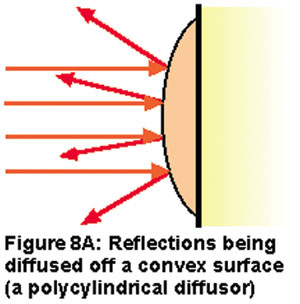
Welcome to Sound Advice on Acoustics! Last time we discussed how reflections from walls and ceiling and floor at the front of the room could be spotted and damped; now it’s time to look at the rest of the room, and one critical piece of studio furniture…The potential problem in having a live rear end of a control room is that too much reflected energy may be directed straight back at the mix position. To avoid this, various techniques have been used to diffuse, or spread out, this reflected sound. One of the simplest and most traditional is the use of a curved rear wall (see Figure 8A).

FIG: 8A
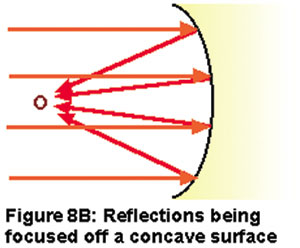
This is a convex surface, which (once again, in accordance with the “angle of incidence” rule) redirects reflections, distributing them throughout the room, instead of letting them beam straight back to the listening position. Even a slight curve will have a useful effect here. This curved surface is called a polycylindrical diffusor, and if there is a cavity behind it, it can also help with low frequency absorption.The thing to avoid most is any concave rear surface, which would focus reflected sound at a particular spot in the room (see Figure 8B), exactly the opposite of the desired result (that may be great for parabolic mics, but not for the back of a studio!).
FIG: 8B

Another approach is to create an irregular surface on the rear walls, to send reflections in many different directions, effectively diffusing the ambient sound field. A wall covering consisting of various sized blocks or grooves can be employed to accomplish this; even a bookcase filled with different-sized books can be pressed into service in a pinch. However, the best results will be achieved when this kind of surface treatment is not just random, but specifically designed to diffuse sound most effectively at a wide range of frequencies.

More recent computer-assisted designs of this type are able to not only distribute reflections around the room, but also deliver an optimum balance and distribution of all the diffused reflected frequencies. There are many types of these diffusors available. One good example of this approach is a quadratic residue diffusor. This is a panel made up of what appears to be a series of blocks or grooves. They’re not just randomly arranged to simply spread out reflections—their arrangement and depths are determined mathematically by a quadratic residue sequence (there’s a mouthful!), to provide the greatest degree of diffusion and the most even distribution of reflected sound.

Fortunately, for those who tend to cringe at anything more than long division, diffusors of this type are available commercially. Though not cheap, they are very effective and recommended if the budget allows.

Room boundaries are not the only surfaces that can generate reflections. How about that great big console right in front of you? Reflections off the console or work surface and other studio gear like racks can also contribute to a loss of clarity.

Console reflections in particular can be problematic, since they originate right in front of the listening position and therefore can be quite strong. If the speakers are wall- or soffit- mounted, an absorbent “hood” can sometimes be placed behind and over the meter bridge to prevent sound waves from hitting the console surface. Reflections from console-top monitors are more difficult to eliminate, but at least choosing monitors with narrow, controlled vertical dispersion and angling them carefully will beam less high-frequency sound down to be reflected off the console surface.

Keep other gear out of the direct path of sound from the speakers—use lower racks, or position tall racks to the rear of the mix position. The sharp edges of most racks diffract sound (diffraction is a change in direction of a sound wave caused by an obstacle)—rounding off such sharp edges helps diffuse such reflections. After the room is initially set up and tuned, checking the acoustics as additional pieces of gear are installed can help to identify and prevent new problems from being introduced.

Another approach to minimizing the problematic effects of strong early reflections is to set up the mix position no more than 3 feet or so from the speakers, placing the listener in the speakers’ “near-field.” Theoretically, in this zone, the direct sound from the speakers should be predominant over reflections from other surfaces, providing a more neutral response even in a room with less than optimal acoustics.

This approach is called Near-Field Monitoring™, a concept that was trademarked by industry veteran Ed Long. It is usually implemented via the use of console-top monitors. This does work fairly well, the sound in this near-field area is often somewhat smoother than sound from the same speakers in the far-field (at greater listening distances) of the same room.

This type of setup is often recommended for studios where, for one reason or another, room treatments are not able to completely control reflection issues (which includes most small studios). However, near-field monitoring is not a panacea for acoustic problems—standing wave effects will still be present, and as noted above, the possibility of close strong reflections from the console itself can still potentially compromise monitoring accuracy.

Next time we’ll wrap up our introductory discussion with a look at live rooms for tracking and a list of references you can look at. See you then!


Part 7

Part 6


Share