Dan Friedman

PROFESSIONAL COACHING 4 VOICE & SOUND

828.551.0891
Dan@Sound4VO.com
  • Home
  • Coaching4VO
  • About
  • Demos
  • Books
  • Services
  • Testimonials
  • Blog
  • Merch
  • Contact

Archives for November 2011

Recording Magazine’s Room Acoustics Series Part 7

November 29, 2011 by Dan Friedman

Recording Magazine sends out a newsletter to its subscribers every few weeks. The newsletter is (coincidentally) titled “Sound Advice” and this month it features the seventh in a series about room acoustics. Room acoustics is one of the biggest concerns for Recording Magazine readers. I know that this is also a big issue for those of you in the voiceover world. I asked permission to reprint this newsletter (and will ask to reprint the others in the series as well) so that those of you with home studios can also benefit from the information. I want to personally thank Brent Heintz, VP/Associate Publisher for granting permission, allowing me to share this great information with you.

Please visit Recording Magazine‘s website and Facebook Page.

Catch up or skip ahead: Part 1, Part 2, Part 3, Part 4, Part 5, Part 6, Part 8.

Here is the seventh newsletter in the series on Room Acoustics:

Welcome to Sound Advice on Acoustics! Last time, we talked about how the timing and placement of sound waves reflected off surfaces in a room can play with our perception of how loud they are, what their tonal quality is, and where they’re coming from. Now that we have a grasp of the problem, it’s time to get it under control so our control room can provide an honest representation of what is coming from our loudspeakers.

One obvious and successful approach is to deaden reflective surfaces by placing absorptive material on them, eliminating problematic reflections. Since we’re concerned with mid and high frequencies here, with relatively short wavelengths, the familiar foam sheets and fiberglass-filled acoustic panels that we often see in studios are readily available and very effective. These can be hung or affixed to walls and ceiling to damp reflective surfaces. As noted earlier, a completely absorptive room would sound unnatural and be unsuitable for any musical application, so the solution is to apply only as much damping as needed to eliminate the most problematic reflections, while allowing enough reflections to remain to give the room an appropriate sense of “liveness.”

Again, the most problematic reflections are the earliest and strongest, coming from reflective surfaces closest to the source. In a control room, if the source is the speakers, this would be the walls and ceiling in the front and front-sides of the room. Reflections from the rear, having traveled a greater distance, would be weaker and, since they arrive much later than the direct sound, will not cause excessive coloration. As a result, they could be allowed to contribute to the necessary ambience in the room. If these rear reflections were further diffused for a more even distribution throughout the room, as described above, that would achieve the best balance while preserving the neutrality at the primary monitoring position (the “sweet spot”).

This approach is often described as LEDE™ (live-end/dead-end), a term and concept introduced by industry veteran Chip Davis (the trademark is held by Synergetic Audio Concepts, Inc.—www.synaudcon.com). Early applications of this technique completely deadened the front of the room (front wall, side walls, ceiling, except of course the control room window), as far back as the mix position. The back of the room was left live and diffused.

Damping the earliest reflections this way increases the initial time-delay gap, the time between the direct sound and the first of the early reflections which determine the acoustic character of the room. Increasing this gap in the control room allows for early reflections in recordings to be heard more clearly, without the control room imposing its own acoustic signature on everything played in it.

The approach works well, providing a lot of clarity at the monitoring position, but can sometimes result in good but slightly dry-sounding spaces. Some modern approaches tend to use a bit less absorption in the front of the room, damping some reflections and redirecting others away from the sweet spot toward the back of the room, where they can be diffused. If done well, this can provide a somewhat more “live” environment while still maintaining the essential clarity.

In a low-budget situation you can target the most problematic early reflections and damp them down even without benefit of the computer programs the pros use for this. You’ll improve clarity without excessive cost or analysis. This can be done by using the “mirror trick” we mentioned last time; here’s how it works.

One person sits in the mix position, while another takes a mirror and moves it around a side wall until the person sitting in the sweet spot can see the speaker on that side of the room reflected in the mirror. This shows the path of a sound originating at the speaker, and reflecting from that spot directly to the listening position, based on the “angle of incidence” rule we learned last time. Remember, light reflects just as sound does, so if you can see the speaker in the mirror on the wall, sound from the speaker will bounce off that spot on the wall and hit your ears!

Applying appropriate damping to that spot on the wall will eliminate (or at least reduce) an early, strong, and most likely problematic reflection. You do the same for such reflective locations at both side walls, ceiling, and even the floor. This isolates the most direct and strongest reflections, and damping them can make a noticeable improvement in clarity at the monitoring position, without overly deadening the room.

Flutter echo is another related problem that arises from reflected sound, especially from lateral reflections: A sound wave hits a parallel wall straight on, and (again, in accordance with the “angle of incidence” rule) reflects straight off and over to the other wall, setting up a repetitive back and forth reflection pattern that can result in an audible metallic “ringing.” As with room modes, splaying the walls to avoid parallelism can prevent this, but so will effective damping, as per above, and damping is certainly easier to implement than wall splaying.

Next time, we’ll consider what’s going on at the back of the room, and consider the problem of reflections off your mixing console. We’ll also discuss what using closely-aimed monitors buys you (and doesn’t). See you then!
Filed Under: Audio Production

Recording Magazine’s Room Acoustics Series Part 6

November 16, 2011 by Dan Friedman

Recording Magazine sends out a newsletter to its subscribers every few weeks. The newsletter is (coincidentally) titled “Sound Advice” and this month it features the sixth in a series about room acoustics. Room acoustics is one of the biggest concerns for Recording Magazine readers. I know that this is also a big issue for those of you in the voiceover world. I asked permission to reprint this newsletter (and will ask to reprint the others in the series as well) so that those of you with home studios can also benefit from the information. I want to personally thank Brent Heintz, VP/Associate Publisher for granting permission, allowing me to share this great information with you.

Please visit Recording Magazine‘s website and Facebook Page.

Catch up or skip ahead: Part 1, Part 2, Part 3, Part 4, Part 5, Part 7, Part 8.

Here is the sixth newsletter in the series on Room Acoustics:

Welcome back to Sound Advice on Acoustics! For the last few installments, we’ve been talking about the basics of room acoustics: how sound moves, room dimensions, and systems for analyzing and dealing with low-frequency problems. As we start to consider the mids and higher frequencies, with the transmission, reflection, and absorption of sound as it travels around our room, we have to have an understanding of how our own hearing systems interpret this barrage of direct and reflected sound. Here we go!

When a direct sound reaches our ears followed by a reflection, how we perceive these two sounds is determined by the arrival time of the reflection. If it arrives less than about 50 milliseconds (thousandths of a second) after the original sound does, we perceive only the original direct sound, but the interference effects contributed by the delayed out-of-phase reflection will color the timbre of that sound.

Our auditory system’s perceptual fusing of the direct and reflected sounds, under the conditions described above, is called the precedence effect (or Haas effect)—the ear integrates all reflections within ~50 milliseconds of the first arrival (direct sound). But if a reflection arrives more than ~50 milliseconds later than the direct sound, it is not perceptually fused with the direct sound and is instead heard as a discrete echo.

The actual threshold of the shift in perception from integration to echoes is gradual between about 25–50 milliseconds, and varies depending on the nature of the original sound. For example, for short percussive sounds with sharp attack transients, the perceptual fusing of direct and reflected sounds may break down at only 20 milliseconds of delay, or even less. (A musician calls this “flamming.”)

The delay, or gap, between the direct sound and the first reflection, as well as the spacing of the other (integrated) early reflections determines the acoustic character (our sense of the size and shape) of the room. If there are enough reflective areas, the later reflections, instead of being heard individually as echoes, build up in density and form reverberation, which continues after the direct sound stops, dying away gradually. Reverberation time (RT60) refers to the time it takes for this reverberant tail to decay by 60 dB. In control rooms this property is usually kept to a minimum by design.

Another aspect of our hearing in regards to direct and reflected sound is described by the “Law of the First Wavefront.” This says that when we hear a direct sound followed by early reflections, our auditory system not only integrates them, but also determines the localization of this combined sound from the direction of the first arriving sound.

So if a sound wave originates from a loudspeaker in front of us and slightly to the left, followed a few milliseconds later by a reflection from the right, we identify everything as coming from the loudspeaker. However, if the reflected sound is about 10 dB or so louder than the direct sound, the localization towards the direction of the first arrival breaks down, the perceived image shifts, and the direct/reflected sound then appears to be spread out between the actual sources.

Another directional aspect of our auditory perception is that reflections from the same direction as the (direct) source can be 5–10 dB louder before being detected than reflections originating from other directions. This is so because the direct sound masks the reflections coming from the same direction. So strong reflections from the sides of the room (lateral reflections) can be more problematic than those from the front.

The presence of early reflections, echoes, and reverberation in a room is normal and adds fullness and a sense of spaciousness to music, but in a control room, too much of this can be a problem. Recordings being monitored already contain recorded ambience, or else they may have artificial ambience added to them, but either way we need to hear the reflections in the recordings more than the ambience of the control room itself. And of course, reflection-based effects like image shifts and colorations of the direct sound also obscure aspects of the recorded sound like panning and tonal balance, so reflected sound must be tightly controlled to insure a good monitoring environment.

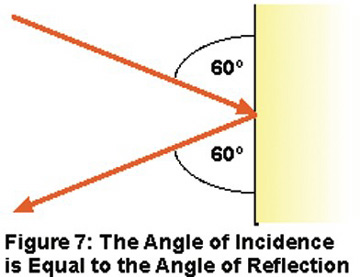
If we’re going to try to control or eliminate certain reflections in a room, we should trace their pathways as they travel through the room. When a sound wave is reflected off a room surface, there is a well-known rule which describes the propagation of that reflected wave: “The angle of incidence is equal to the angle of reflection.” This means that for whatever angle a sound wave strikes a reflective surface, it will bounce off that surface at an equal but opposite angle (see Figure 7). You can see this for yourself by bouncing a flashlight beam off a mirror—and this is actually the basis for a handy means of dealing with these reflections that we’ll discuss next time (which we call the “mirror trick”).

The most problematic reflections are the earliest and therefore the strongest. By applying the above rule, reflection pathways can be predicted, and strong reflections can usually be traced from the source (i.e. loudspeaker) to the positions on nearby reflective surfaces where these worst offenders originate. Next time we’ll begin to discuss how to deal with these problem reflections, and we’ll teach you the mirror trick as well. See you then!

Filed Under: Audio Production

In Memory – Bill Thomas

November 10, 2011 by Dan Friedman

From a whisper to a scream, Bill Thomas could do it all. There are few voices that are as big and booming and yet still as versatile as was the voice of Bill Thomas. There are even fewer people left in this industry who have the knowledge, perspective and technical skill that Bill possessed.


While Bill was often cantankerous and opinionated outside of the booth, he was also supportive and caring of those around him. He could drive people crazy and even make a person angry when he expressed his personal views and thoughts about the world. However, he never said a bad word about anyone personally. In fact, whether you agreed with him or not, he would still treat you with genuine respect, care and concern.

He was always at his best when he was in front of the microphone. I will remember him most fondly for being incredibly diverse, remarkably charming and exceptionally talented. His comedic timing, microphone technique and copy interpretation were all pure perfection. He was generous with compliments to the talent around him, including the writers, directors and engineers. He had a great ear and never complained about doing more takes if needed. He generously offered to work “until the point of diminishing returns” as we would frequently say. It was as though he never wanted to leave the mic.

I will miss working with you Bill.

I will end with the same words with which you often ended your recording sessions, “It was an honor and a pleasure.”

Click below to hear the amazing Bill Thomas:

In Memorium Bill Thomas
5582
https://sound4vo.com/wp-content/uploads/2023/05/DanFriedman_InMemorium_BillThomas.mp3

Filed Under: Sound4VO News

Primary Sidebar

Search Blog

Categories

Want to see how well we work together first? LET’S DO IT!!

Book a Single Session
Book a FREE Meet & Greet

Follow Sound4VO

Dan Friedman Voice Over Coach & Demo Producer Tiktok

Tip Jar

Have questions on anything related to voiceover? Dan is available for email consultations at no charge. Ask away! If he's able to help you with your problem, tips are greatly appreciated... Use the "tip jar" below to show Dan the love!

Dan Friedman Voice Over Coach & Demo Producer Tiktok

Dan@Sound4VO.com

828.551.0891

Dan Friedman Voice Over Coach & Demo Producer Zen and the art of Voiceover Audiobook Cover Img
Buy Now
Dan Friedman Voice Over Coach & Demo Producer Sound Advice Cover Img
Buy Now

VQ CERTIFIED MASTER COACH Since 2021

Dan Friedman Voice Over Coach & Demo Producer VQ Logo

©2026 Dan Friedman Sound4VO // Voice Over Site by Voice Actor Websites

MENU
  • Home
  • Coaching4VO
  • About
  • Demos
  • Books
  • Services
  • Testimonials
  • Blog
  • Merch
  • Contact